

Inspired by insights from an exclusive industry roundtable discussion, this article explores how stablecoins, AI-powered treasury, and next-generation payment infrastructure are reshaping the future of cross-border finance and global liquidity.
For years, global businesses accepted cross-border payments as a necessary operational bottleneck.
- Long settlement cycles.
- Unpredictable FX costs.
- Limited visibility into incoming payments.
- Liquidity trapped across markets.
- Manual reconciliation processes.
These inefficiencies became normalized because the global financial system was never designed for the speed and complexity of today’s economy.
That assumption is now being challenged.
A new generation of payment infrastructure powered by stablecoins, real-time settlement networks, AI-driven treasury intelligence, and digital liquidity solutions is fundamentally reshaping how money moves across borders. What was once considered emerging technology is rapidly evolving into enterprise infrastructure.
And for treasury leaders, the implications are strategic—not experimental.
The Global Payments System Is Under Pressure
The world economy is becoming more fragmented, volatile, and digitally connected all at once.
Geopolitical tensions, supply chain disruptions, inflationary pressures, and shifting trade corridors are forcing businesses to rethink how they manage liquidity globally. At the same time, enterprises are expanding into faster-growing but operationally complex markets across Southeast Asia, Africa, Latin America, and the Middle East.
Yet many businesses still rely on legacy payment systems built around:
- Multiple intermediary banks
- Delayed settlement cycles
- Limited payment transparency
- Fragmented FX conversion processes
- Region-specific banking constraints
In today’s environment, these inefficiencies directly impact working capital, supplier relationships, and revenue predictability.
The question is no longer whether cross-border payment infrastructure needs to evolve. The question is how quickly businesses can adapt.
Why Stablecoins Are Moving Beyond Crypto
Much of the public conversation around digital assets has focused on volatility and speculation. But behind the headlines, stablecoins are emerging as one of the most practical innovations in modern finance.
Unlike traditional cryptocurrencies, stablecoins are pegged to fiat currencies such as the U.S. dollar and are designed for stability rather than speculation. Their real value lies in enabling faster, lower-cost, and more accessible cross-border transactions.
For businesses operating across emerging markets, this solves a very real problem.
In many regions, accessing USD liquidity remains difficult due to capital controls, limited banking infrastructure, or fragmented local financial systems. Traditional international transfers can take days to settle and often involve high conversion costs and poor visibility.
Stablecoin-based settlement introduces a different model:
- Near real-time cross-border transfers
- Reduced dependency on correspondent banking networks
- Faster payment reconciliation
- Lower transaction friction
- Improved access to global liquidity
Importantly, enterprises do not necessarily need to hold or manage digital assets directly. Increasingly, financial providers are abstracting the complexity away from end users, allowing businesses to access the efficiency of blockchain-based settlement while still receiving fiat currency into traditional bank accounts.
That distinction is accelerating enterprise adoption.
Treasury Is Becoming a Strategic Growth Function
The role of treasury is also evolving.
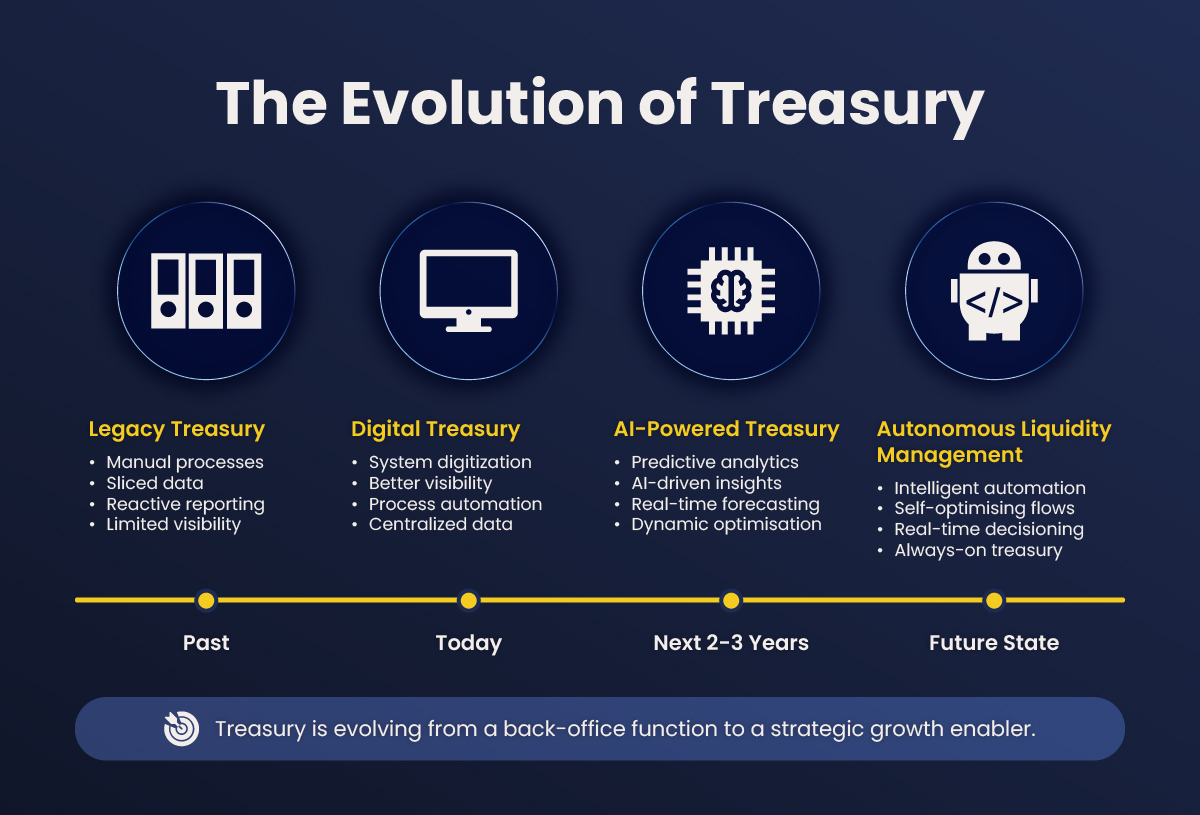
Historically, treasury teams focused on liquidity preservation, cash positioning, and risk management. Today, they are becoming central to business agility and global expansion strategies.
Why?
Because in volatile markets, the ability to move capital quickly and efficiently becomes a competitive advantage.
Modern treasury leaders are now expected to manage:
- Real-time liquidity visibility
- FX volatility exposure
- Cross-border cash optimization
- Faster settlement expectations
- Global supplier payment complexity
- Regulatory and compliance risk
This is where AI and intelligent treasury infrastructure are beginning to play a transformative role.
AI-powered treasury systems can already:
- Forecast liquidity needs in real time
- Detect payment anomalies
- Optimize FX routing
- Automate reconciliation workflows
- Predict working capital gaps
Combined with real-time payment rails and digital settlement infrastructure, treasury operations are moving toward a future that is increasingly automated, predictive, and always-on.
Emerging Markets Will Shape the Next Phase of Innovation
One of the most important shifts happening today is where innovation is accelerating.
While mature economies continue modernizing existing systems, many emerging markets are leapfrogging traditional infrastructure entirely through mobile-first financial ecosystems and digital payment adoption.
This is especially visible across:
- Southeast Asia
- Africa
- Latin America
- The Middle East
In these regions, businesses are prioritizing payment accessibility, speed, and liquidity efficiency over legacy financial processes.
Cross-border commerce is increasingly happening between businesses that need:
- Faster access to funds
- More transparent FX pricing
- Reduced settlement delays
- Alternative payment options beyond traditional banking rails
As these trade corridors expand, businesses that modernize their payment infrastructure early will be better positioned to scale internationally.
The Future Is Not Banks Versus Blockchain
One of the biggest misconceptions in the market is that digital assets will replace traditional banking systems.
The reality is far more nuanced.
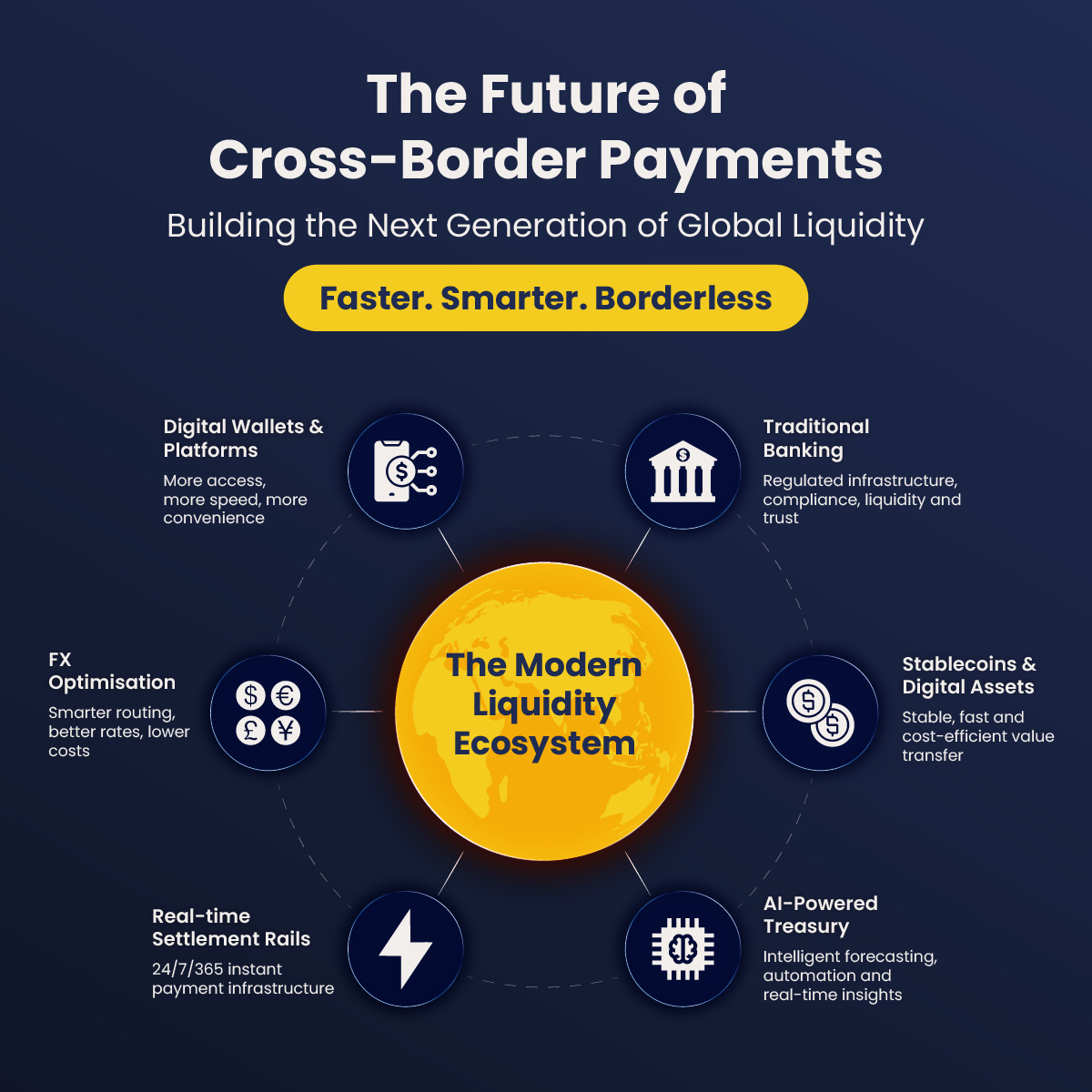
Banks remain essential for compliance, risk management, trade finance, liquidity provision, and regulatory oversight. What is emerging instead is a hybrid financial ecosystem where traditional finance and digital infrastructure work together.
Over the next decade, the most successful financial ecosystems will likely combine:
- Regulated banking infrastructure
- Real-time payment capabilities
- Stablecoin settlement rails
- AI-driven treasury intelligence
- Embedded finance solutions
The winners will not simply be the fastest adopters of technology. They will be the organizations that successfully integrate innovation into scalable and compliant financial operations.
The Next Competitive Advantage Is Liquidity Agility
The future of global trade will be shaped not only by products, supply chains, or market access—but by how efficiently businesses can move money across borders.
Cross-border payments are no longer just a finance function. They are becoming a core driver of operational resilience, customer experience, and growth strategy.
In a world where global commerce operates 24/7, businesses can no longer afford payment infrastructure that moves at yesterday’s speed.
The transformation has already begun. The next phase belongs to organizations prepared to rethink liquidity, treasury, and cross-border finance for a digitally connected economy.